
Bank-Grade Security Vault
There is no private key. Ever.
Alph AI · MPC Keyless Security System
If it breaks, we pay.
Alph AI elevates wallet security to a system-grade capability: MPC keyless, zero-attack-surface isolation, AWS Nitro Enclaves, and full-path risk control—bank-grade, verifiable, auditable, reusable.
Hackers can’t steal what never exists.
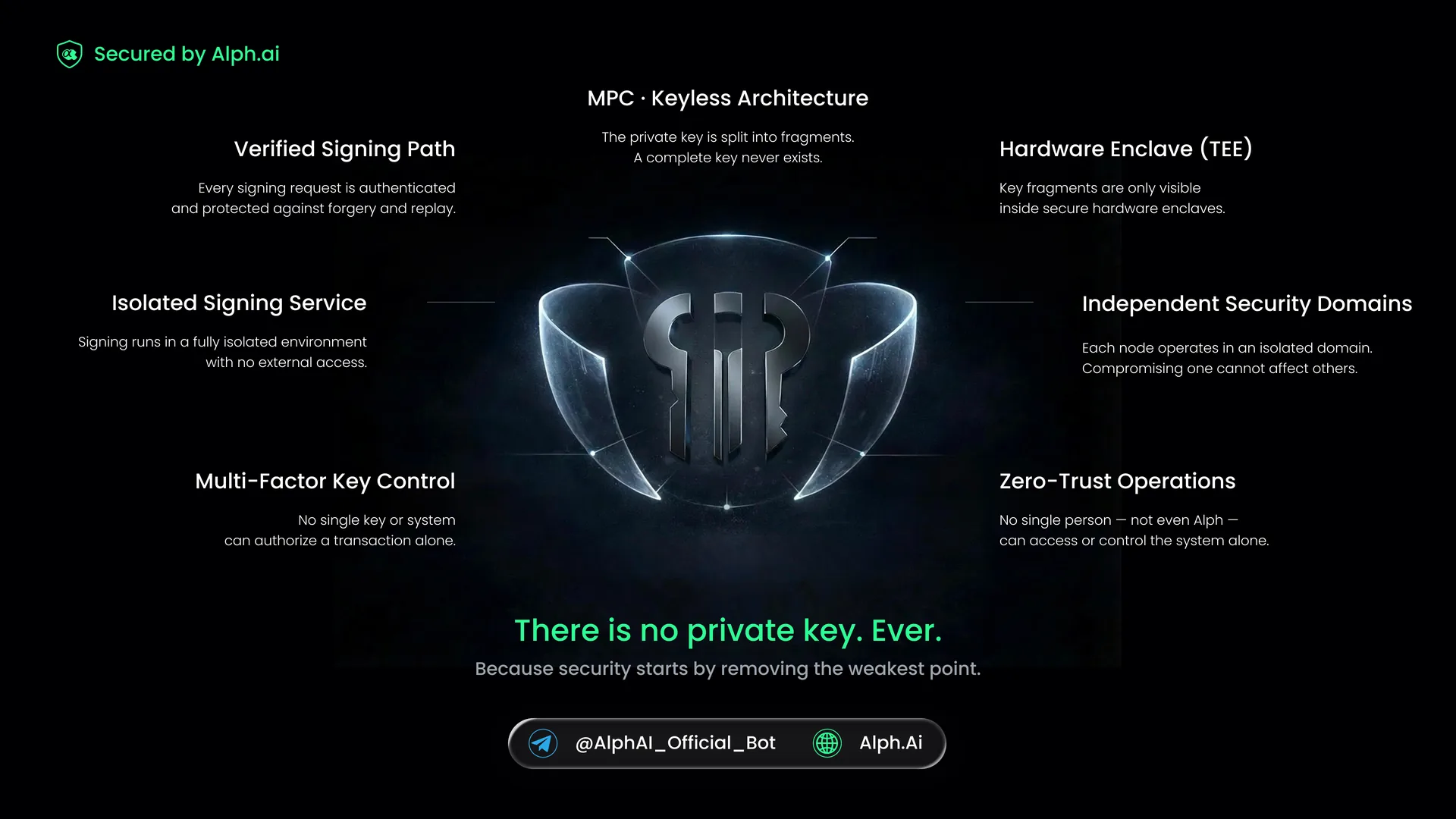
Security Summary
“There is no private key. Ever.”
Private keys never fully exist; the attack surface disappears at the root. Asset security relies on verifiable cryptography and physical isolation, not single-point trust.
7-Layer Defense
Alph.ai 7-Layer Defense
MPC 3-of-3 / 2-of-3
“Keyless” design: the key is split into 3 shards, signing needs only 2; the full key never exists.
“Hackers can’t steal what never exists.”
Isolated Signing Service
“Zero Attack Surface”: signing runs in fully isolated networks with no external entry points.
“Not just defense—there is no path in.”
Physical / Network Isolation
Independent security domains with physical isolation. Compromise in one node can’t spread.
“Mutual distrust is the strongest trust.”
TEE(AWS)
“Bank-grade isolated vaults”: sensitive computation happens only inside AWS Nitro Enclaves.
“Verifiable execution in isolated enclaves.”
Multi-Factor Key Control
No single key can unlock. Attackers must compromise multiple teams, systems, and layers.
“Attack difficulty grows exponentially.”
Signature Path Verification
End-to-end auth for every signing request with anti-forgery and anti-replay checks.
“Every transaction has an ID.”
Zero-Trust Ops
MPC for ops: no single insider can access critical steps. Everything is audited.
“Eliminate insider abuse.”
Core idea: turn attack cost from addition to multiplication. No single layer compromise reaches assets.
Keyless Vault
MPC / TSS Wallet System
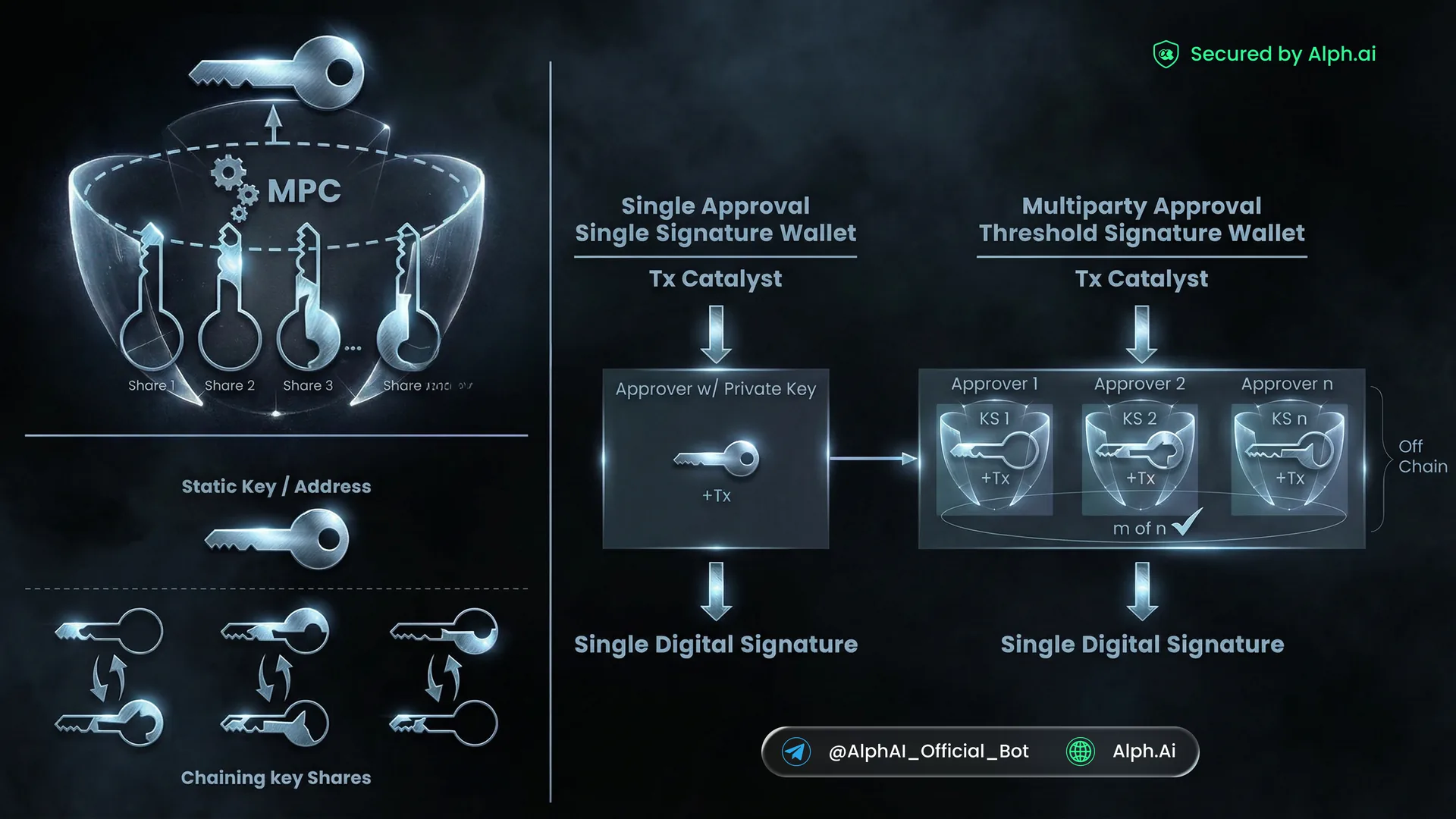
Distributed key generation and threshold signing turn attack cost from addition to multiplication. The full private key never exists; single-point leaks are ineffective.
Key Sharding
Key shards only; the full key never exists.
Threshold Signature
2-of-3 / 3-of-3 threshold co-signing.
Security Domains
Multi-domain isolation + no public signing nodes.
Distributed Key Generation (Illustration)
Traditional: generate full private key →private_key = generate_private_key()
MPC: distributed shard generation →shard_1, shard_2, shard_3 = generate_shards_in_distributed_manner()
Key point: no device/person ever sees the full private key.
TEE Enclave
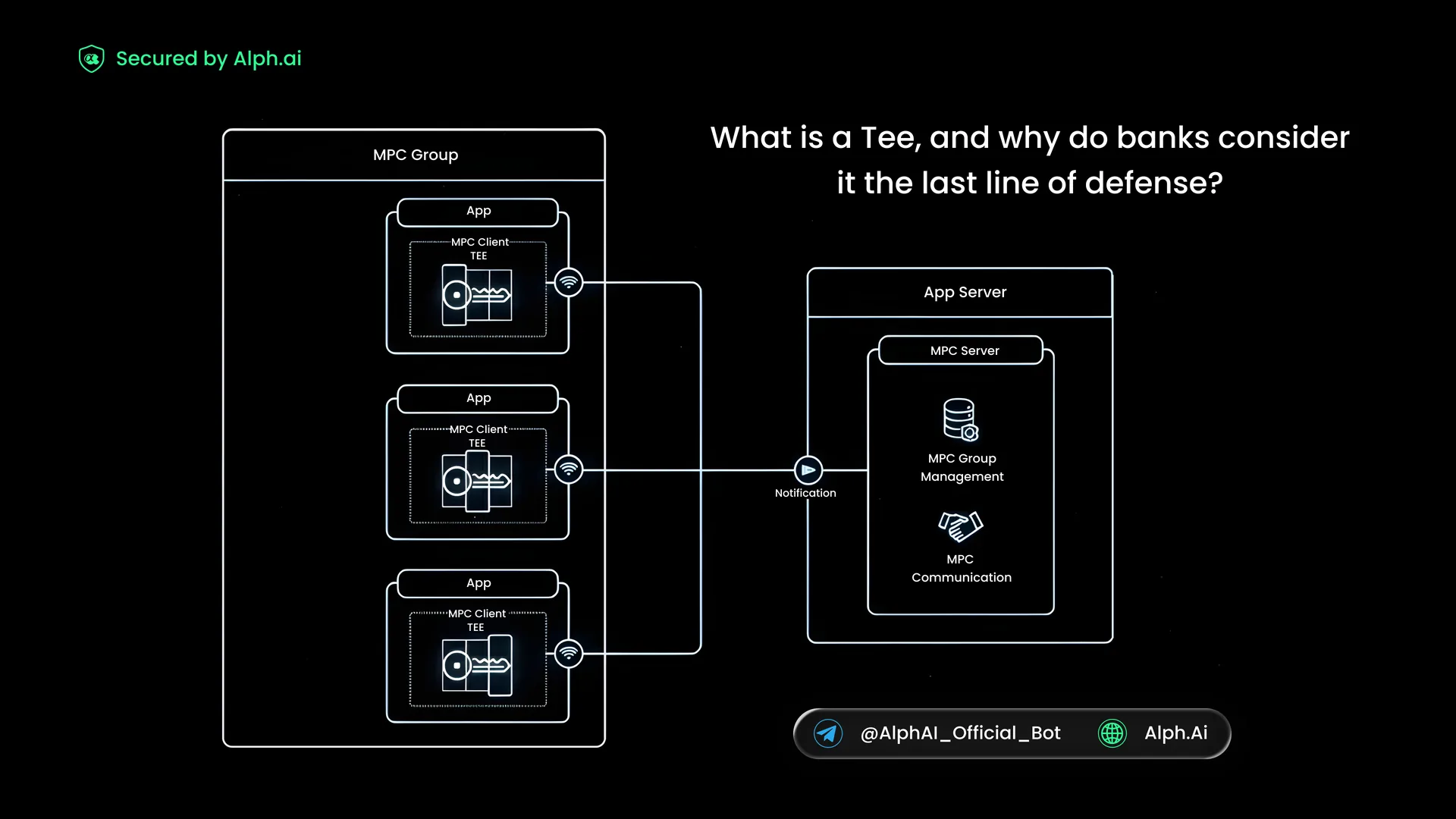
Trusted Execution Environment (TEE)
Shard decryption and signing occur only inside the enclave. Remote attestation verifies integrity and mitigates memory extraction and supply-chain risks.
- AWS Nitro Enclaves
- Memory encryption + sealed storage + remote attestation
- Cross-platform secure base to reduce single-vendor dependency
Zero-Trust Infrastructure
Zero-Trust Infrastructure
Zero-Trust Ops Principles
- Four-eyes rule: critical actions require two independent approvals.
- Time-bound access: temporary privileges auto-expire.
- Behavioral baselines: anomalies alert in real time.
Network Topology
Network Topology: Zero Attack Surface
Pre-Trade Risk Scan
Contract Risk Pre-Check Pipeline
Within milliseconds after you input a contract address, the system runs rules, symbolic execution, and AI semantic analysis in parallel to produce a structured risk report and recommendation.
- Address input → fetch bytecode
- Parallel analysis (< 3s)
- Rules engine: match 300+ risk patterns
- Symbolic execution: detect hidden logic paths
- AI semantics: infer real contract intent
- Structured report
- Risk score (0–100)
- Key risks (taxes, blacklist, etc.)
- Recommendation (block / warn / allow)
Execution Simulation
In-Trade Execution Simulation
Simulate critical scenarios in parallel to assess slippage tolerance and sandwich risk to avoid failed executions.
- Slippage shock: price impact tolerance
- Gas volatility: cost control check
- MEV sandwich: anti-front-running simulation
- Callback: re-entrancy defense
- Extreme moves: cliff-drop risk
Post-Trade Monitoring
Post-Trade Holdings & Liquidity Monitoring
Execution is the start of risk. We continuously monitor holdings, LP changes, and permission changes, triggering alerts and providing stop-loss and replay tools.
- LP volatility & withdrawal alerts
- Top holder movement detection
- Permission changes & upgrades
- One-click stop loss + risk replay
MPC × Risk Engine
MPC Signing Interlock
Risk controls are tightly coupled with MPC signing to form a detect–block–audit loop. High-risk transactions can be denied before signing.
- Risk score < 30: deny signing
- Rug confirmed: trigger temporary freeze
- Blocks logged into zero-trust audit
Audit & Transparency
Audit & Transparency
All signing requests, TEE attestations, and network metadata are auditable. Quarterly penetration testing and protocol verification sustain transparency over time.
- Real-time audit: signing logs + attestations
- Quarterly third-party tests & formal verification
- Public transparency reports & bug bounty updates
Security Team
Bank-Grade Security Team
The security vault is designed and maintained by a team spanning TradFi and Web3 security expertise.
Core Lead
Led by CTO Evan, the team has led key audits, fixed critical vulnerabilities, and presented on on-chain signing.
- Led major CertiK audits
- Fixed multiple critical issues
- Shared on-chain signing practices
Cross-Disciplinary
Core members span TradFi and Web3 security firms with 150+ DeFi, Layer1, and bridge audits.
- From top banks / payments risk teams
- SOC2 / ISO 27001 expertise
- From CertiK, Quantstamp, PeckShield
Strategic Partner
Partnered with Bitrue’s 8-year security team to strengthen on-chain asset protection.
We’re building a bank-grade security vault, not just a trading platform.
Alph Video
Private keys should never exist.
How MPC makes hacks impossible